With the development of the automotive industry, both the efficiency improvement of traditional fuel vehicles and the range requirements of new energy vehicles have brought more innovation opportunities and market demands to the field of automotive thermal management.

Driven by the rapid development of my country's automotive industry, vehicle thermal management based on water pump temperature control is gradually evolving towards intelligence, autonomy, and systematization, placing higher demands on underlying core chip products. The vehicle thermal management architecture is evolving from a decentralized to a highly integrated system, with deep integration of temperature control in subsystems such as air conditioning, battery, and electric drive, requiring higher control precision, energy efficiency regulation, and system response speed.

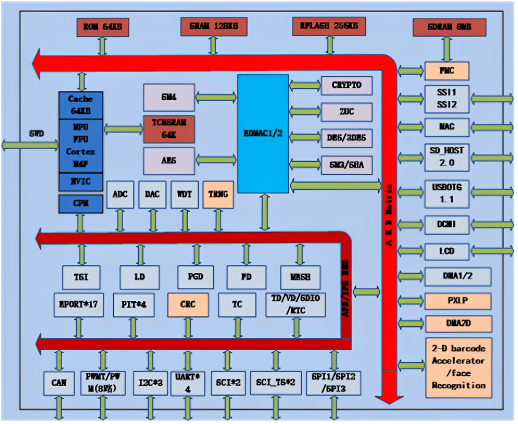
A highly integrated system architecture design. By integrating control algorithms, sensor interfaces, motor drives, communication modules (such as CAN/LIN), and power management functions into a single chip, advanced SoC (System-on-a-Chip) design technology is employed. Hardware acceleration units (such as FPGAs or NPUs) optimize algorithm execution efficiency, while low-power design and multi-core processors enable efficient task scheduling and real-time control. Modular design and automotive-grade verification ensure stable system operation in complex environments such as high temperature and high humidity, ultimately achieving a highly integrated, high-performance, and low-power automotive-grade temperature control solution.
The delay time from sensor data input to control output is less than 10ms;
The power consumption is less than 1mW in standby or hibernation mode; and less than 100mW in normal operation mode.